Harvested Insights
Forward Deployed Engineering: Closing the Last Mile of AI
The 95% problem
MIT studied 300 enterprise AI deployments. 95% produced no measurable impact on profit and loss.
The models were fine. The deployments died.
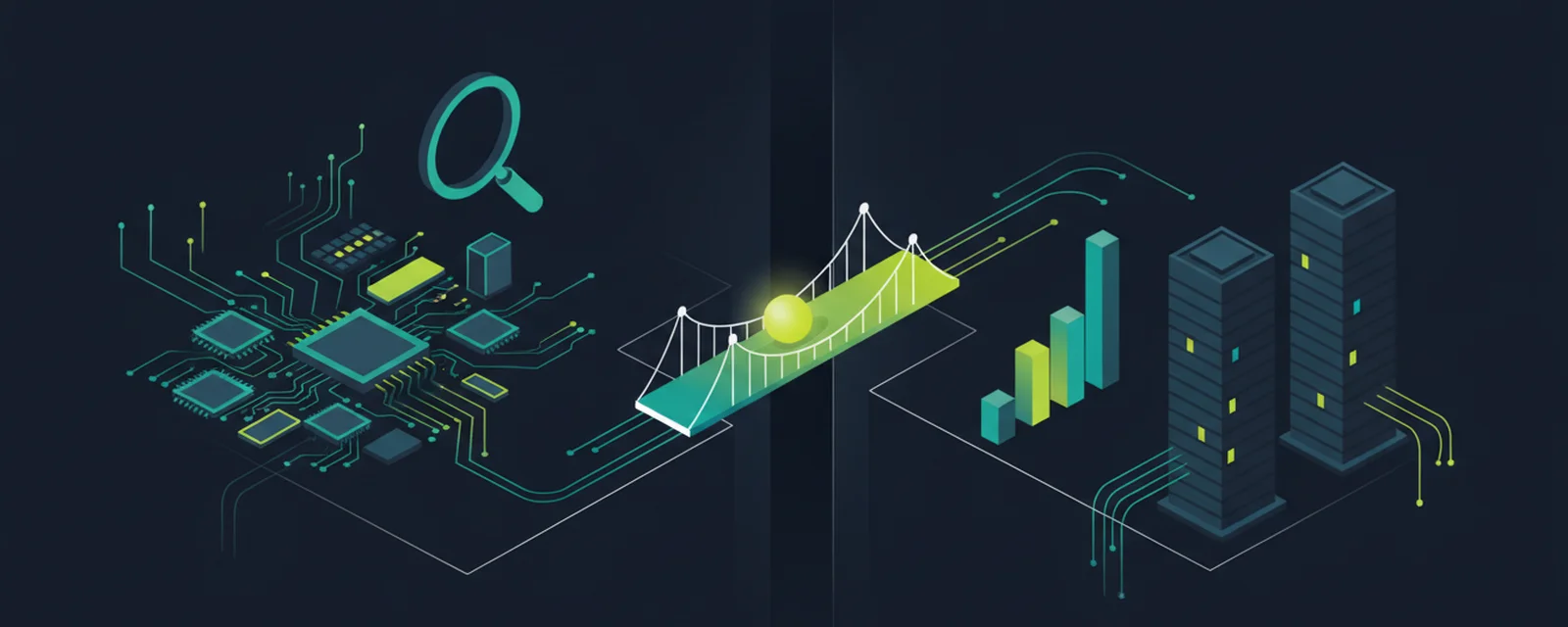
They died because nobody could make AI talk to a legacy database, pass a compliance review, and survive being handed to the operations team that inherited it. The demo was beautiful. The last mile — between a working model and a working business — was never crossed.
That gap is where Nostics works. We close it with Forward Deployed Engineering (FDE): engineers embedded inside your business who ship production AI systems on your infrastructure, with your tooling.
What a Forward Deployed Engineer is
Not a consultant. Not a solutions architect. Not a rebrand of an old slide deck.
A Forward Deployed Engineer closes the last mile between an AI product and real enterprise value. Palantir's internal definition says it best: "FDE responsibilities look similar to those of a startup CTO — you work in small teams and own end-to-end execution of high-stakes projects."
Three hats, worn at the same time:
- Software engineer — real code, on your infrastructure, with your tooling. Not a prototype on dummy data. Production code in production systems.
- Business consultant — understands your domain, maps your processes, translates business pain into technical scope. Two clarifying questions should save three days of engineering.
- Product manager — feeds real-world pain back into the product. The best FDEs don't just deploy software; they reshape it.
The result: a founding CTO embedded inside your company, with the full engineering resources of Nostics behind them.
What Nostics ships
Here's the difference between a demo and a deployment: what happens after the applause.
- MCP servers — the integration layer that connects AI to your actual systems: your ticketing, your warehouse, that internal API with no documentation and one person who understands it.
- Agent skills — your process encoded, so the model follows your workflow, not a generic one.
- Subagents — long-running tasks that survive context windows.
- Operational Engineering consultants — the Nostics 7P method applied to unearth friction points before a line of code is written.
- Long-term agent memory management — goals, processes, and steps described in Open Knowledge Format (OKF), so the agent holds the context it needs to clear the friction — not just run a task once.
- Compliance-grade artifacts — audit rows written because your compliance team demands them, schema quirks absorbed at the integration layer, docstrings that say when to call a tool, not just what it does.
Deployed where you already work. Not in a new app.
The human last mile: why change resists
Here's the uncomfortable part: most of those 300 deployments weren't killed by bad models. They were killed by unmanaged change.
AI makes change resistance worse than any technology that came before it. A new ERP changes a screen. An AI agent changes how people think, decide, and work — every day, and then it keeps changing. This isn't a migration with an end date; it's a permanent state of change. And most organisations manage that badly — change management reduced to a kickoff email, a town hall, an FAQ nobody reads.
The Lippitt-Knoster model of complex change has been saying this for decades: real change needs vision, skills, incentives, resources, and an action plan. Skip one and the failure is predictable — confusion, anxiety, resistance, frustration, false starts. Jeff Winter's adaptation for digital transformation adds strategy, objectives, capabilities, architecture, a roadmap, and projects. Miss any one of those, he warns, and your digital transformation could stumble or even fail.
The 95% problem isn't a model problem. It's a change problem that nobody assigned an owner.
That's what the FDE actually is: the owner of stickiness. Not flown in for a workshop and flown out again — embedded, in your operations, until the system and the people using it move as one. The FDE encodes your process into agent skills so the model follows your workflow, writes the artifacts your compliance team demands, and hands over to the team that inherits it — so week two feels like week one. When the change is engineered into how you already work, there's nothing left to resist.
How it fits the Nostics stack
The worst hour of the week is the best place to start.
- Diagnose — Pulse! diagnostics and the 7P method find the bottleneck and the operating-model misalignment first.
- Deploy — the FDE ships the AI system that removes the worst hour of the week, inside the systems that already exist.
- Thrive — ISAaaS takes over as the always-on agent layer: briefings, client intelligence, document automation, compliance guards.
The progression: diagnose the bottleneck → deploy the fix → leave behind a managed agent that keeps running.
Proof it works: the ISAaaS precedent
FDE didn't start from a whiteboard. It grew out of ISAaaS — Industry Solutions with Agents as a Service — our hosted, managed agent service for businesses with one to three people, powered by Hermes Agent.
The first industry was property.
We built ISAaaS for Sebastiaan, a high-end property agent in Pretoria. His bottleneck was time: admin overload, legal complexity, and marketing demands were eating the hours he should spend with clients. Day one, he got:
- A COO agent that knows his goals, areas, and client base — a strategic conversation partner.
- A daily morning brief on property news in Menlo Park and Waterkloof, delivered before 7am.
- Client intelligence profiles that capture every conversation and flag follow-ups.
- A compliance guard that keeps his outreach POPIA-compliant.
Month two added a social media engine, a marketing campaign builder, and a document generator. The result: more time with clients, less time fighting paperwork. His agent works while he sleeps. He never had to "adopt" the agent — it became part of how he works, which is the only change management that ever actually works.
Property was the first industry — more are in the pipeline, each running the same playbook. FDE is that playbook scaled to enterprises: instead of a managed agent for a one-person firm, an embedded engineer ships the system inside a company that runs its own infrastructure, then hands it to an always-on agent layer.
Who it's for
Scaling enterprises that:
- run legacy systems and an undocumented internal API with exactly one person who understands it;
- have survived two dead AI pilots and now face an ops team that is — rightly — sceptical;
- have a compliance department that must sign off before anything ships;
- can't get AI past the demo stage.
If that sounds like you, the problem was never the model. It was the last mile — and the change that comes with it.
Why Nostics
Two decades of enterprise operations — IBM, T-Systems, Epiroc, executive turnarounds. We lead with operations and prove with AI. We don't sell models; we ship systems that survive week two — and the people who run them survive it with them.
Start Diagnostic → — and let's find out what your company looks like with an FDE on the team.